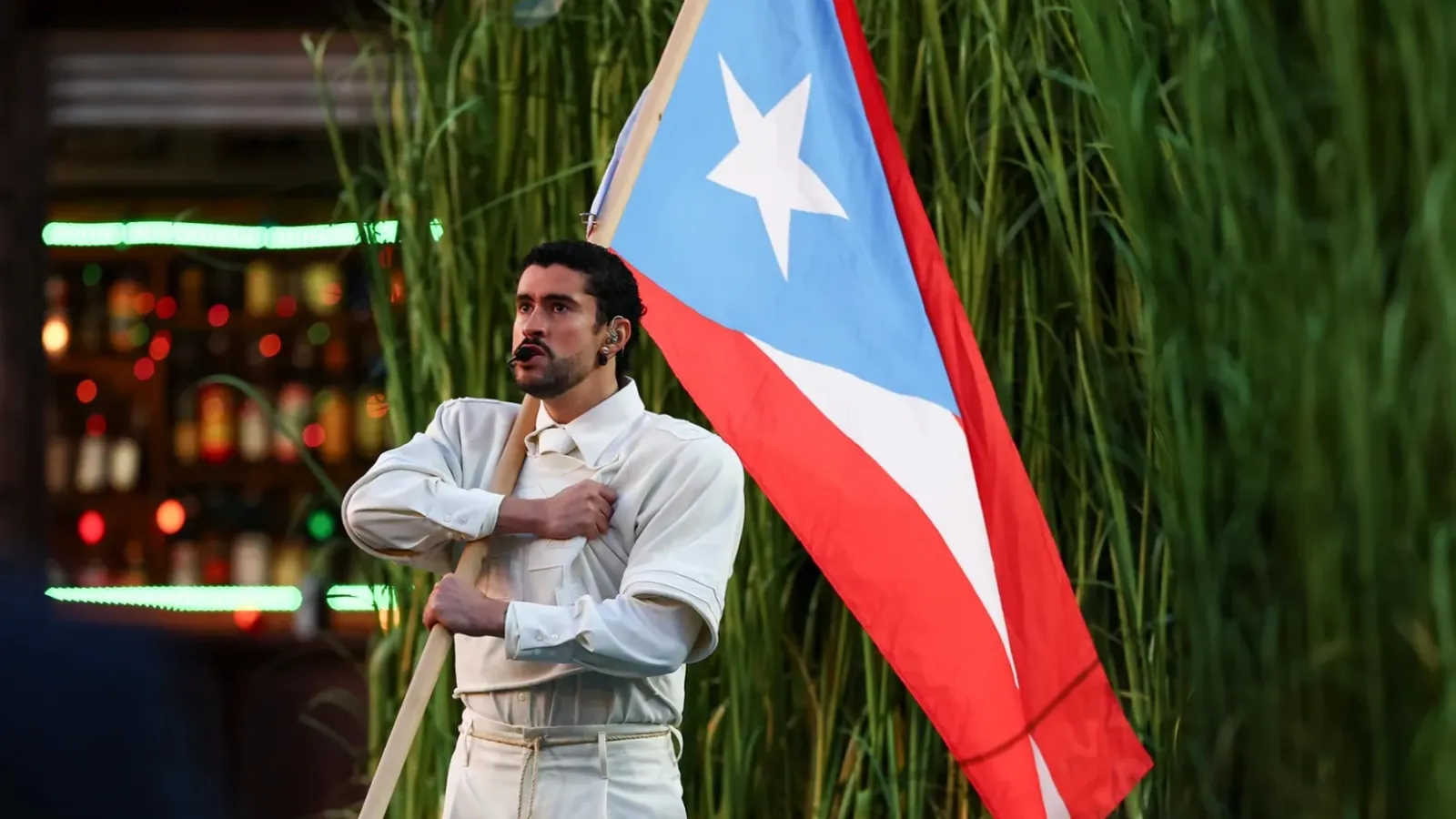
Bad Bunny: A Barrier-Breaking Performance
Story written by CLAS Spring 2026 interns Gabrielle DeMarco and Sadie Urso Kriska. Gabby is an International Studies-International Affairs and Diplomacy major, with a minor in Spanish; Sadie is a double major in International Studies and Political Science.
On Sunday, February 8th, Super Bowl LX drew in viewers from all around the world. Notably, the halftime performance broke the record for most watched super-bowl halftime show ever, with approximately 128 million views. This show especially hit home for many Puerto Rican and Latinx viewers across the Americas because of the performer Bad Bunny. Bad Bunny is a Puerto Rican rapper, singer, and producer. He is arguably one of the most popular music artists in the world, being named Spotify’s most-streamed artist four times, including for 2025, and receiving the 2025 Grammy for “Album of the Year.” He was also the first artist to perform a Super Bowl halftime show entirely in another language: Spanish.
Bad Bunny faced a lot of backlash leading up to the show, with many people claiming a halftime show sung in Spanish was un-American, despite the fact that the United States has no official language and Puerto Ricans, like Bad Bunny, have U.S. citizenship. Through this performance, Bad Bunny displayed many beautiful parts of Puerto Rican culture and emphasized that the Americas are more than just the United States. Many of us were not awareof the extent of the meaning behind his songs. As casual Bad Bunny listeners, and monolingual Americans, researching for this article left us authors in awe of just how popular Bad Bunny is and what he represents. We were inspired to reach out to our Latinx community on campus to understand how important this representation was for them. Full of symbolism and joy, the show received some great reactions across communities, but particularly the Puerto Rican community.
Peruvian-American student Andrea Barrera, who is a member of Alpha Psi Lambda here at The Ohio State University, the Nation's first and largest co-ed Latinx Fraternity, shared her feelings about how the halftime show created a sense of pride in her community: “We have never had such a raw and loud show of our culture on the world’s biggest stage before.” She appreciated all of the small but important parts of her culture that were displayed during the performance. It served as a unifying and enjoyable experience with her family and friends. She stated, “Overall, the emotions from the public and the Latino community were one of pride and enjoyment that someone stepped up and used their voice to represent all of us, especially in a time when our voices are drowned out.”
The performance began by immersing us directly into an extremely relevant part of the Puerto Rican landscape with a set created to represent Puerto Rican sugar cane plantations. In the 19th and early 20th century, sugar was a very prominent part of the Caribbean economy. Up until Spanish colonial rule ended slavery in 1873, enslaved Africans worked on these plantations. In December 1898, the Treaty of Paris marked the official transition from Spanish colonial rule to a U.S territory. The United States took full advantage of the plantations by continuing to exploit local workers and land, and hoarding immense profits. The choice to begin the show in this way spoke to the land's historical struggle for independence and the continuous exploitation of Puerto Rican and African populations by rotating Western powers.
Dr. Fernanda Díaz-Basteris, Assistant Professor of Latinx New Media and Ethnic Studies at Ohio State, focuses much of her research and teachings on U.S Caribbean/Latinx resistance to displacement, coloniality, and racial capitalism. When asked about her reaction to the performance she shared, "His performance brought my community together; with anticipated joy and excitement, we gathered to celebrate Latine heritage, Spanglish, and resistance to the constant attacks rooted in language and racial profiling”. She explained how this moment links scholarship to personal experience and will be especially memorable to people in her field.
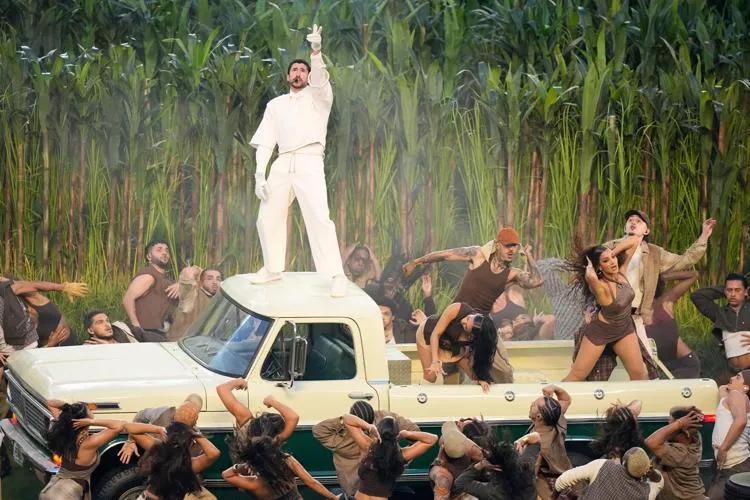
During the performance, Bad Bunny continues moving through the fields, panning to different scenes of Puerto Rican representation, including a Coco Frio cart (cold coconut), elderly men or “viejitos” playing dominoes, a nail salon, a piragua cart (a nostalgic piece of Puerto Rican culture known for selling shaved ice), and many other examples of Puerto Rican work and culture. A more subtle message was sent when he approached a group of female construction workers surrounded by stacks of cinder blocks. “With women being the sole focus in this scene, we’d like to think that this represented the rebuilding of Puerto Rico following Hurricane Maria in 2018. This also highlights how women spearheaded the recovery efforts where FEMA fell short” (Billboard, 2026). The deliberate choice to include such scenes was an ode to the strength, unity, and resilience of the Puerto Rican community as well as a political statement that pointed to the failures of the U.S. government.
A staple in Bad Bunny’s performances, la casita (the little house), built to resemble common Puerto Rican architecture, is shown filled with prominent Latin American celebrities dancing and celebrating together. Frederick Aldama, professor in the Department of English at the University of Austin-Texas, explains in Latinx Pop Magazine, “The casita on the field wasn’t a house. It was a statement about who gets to be home on American television.” (Aldama, 2026). He explains how Spanish culture has always been used as a form of decoration rather than direct dialogue. It is seen through background characters or joked about, but never as the main spectacle. The entire performance was done in Spanish and not made to cater to the understanding of English speakers, but rather to reinforce that English is not the only language that is spoken here, and it’s time we stop acting like it is.
Dominican-American student, Elyanna Rondon, a senior in the College of Social Work, is an avid listener of Bad Bunny's music, listening about four to five times a week. In anticipation of the show, she was eager to see a performance that positively highlighted the Latino population in mainstream American media, especially a show performed entirely in Spanish. She explained that the impact on the larger Latino community is the overall message that there are a lot of us here in America, and we all deserve to be here. The kind of representation we saw in the half-time show is not just for the Latino community, but for everyone! She concluded, “It’s a reminder that everybody is different and has different adaptations of American culture, and they are all valid.”
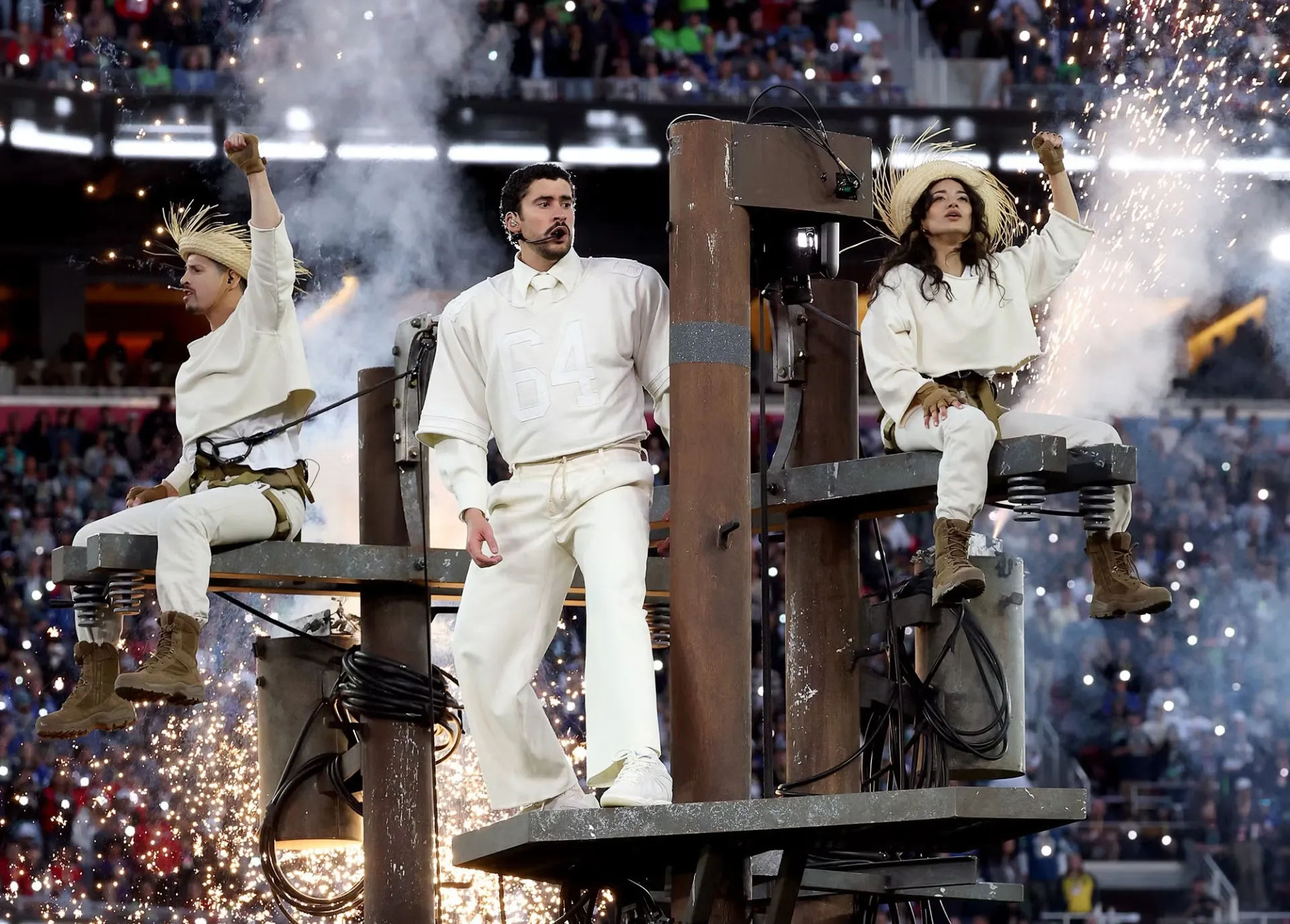
The set during his song, “El Apagón,” translating literally to "The Blackout," symbolizes the crippling power grid issues experienced in Puerto Rico. Dancers and Bad Bunny alike were shown climbing and dancing on electric towers, referencing the U.S.’s continuous failures to properly manage Puerto Rico’s energy grid. “Even without accounting for electricity interruptions resulting from major events such as hurricanes, customers in Puerto Rico experienced on average 27 hours of power grid interruptions per year between 2021 and 2024. By comparison, electricity customers in the mainland United States generally experience about two hours of electricity interruptions per year without major events” (EIA, 2025). Many might turn a blind eye to the use of a set like this, and regard it as nothing more than a cool background. However, understanding the meaning behind the song and the varying sets emphasizes the intentionality behind every decision in the performance.
Bad Bunny ended his barrier-breaking performance on a note of unity. He mentioned and displayed the flags of every country in America, making this a truly All-American performance. The halftime show was densely packed with Puerto Rican culture, but regardless of the language you speak, the message of unity and togetherness amongst all Americans was clear. His last message to the American people, ‘Seguimos aquí’, translates to ‘We are still here.’ No matter the ignorance or lack of representation, Puerto Rico is strong and still fighting.